Company Formation - Banner 1

Why Choose Saudi Arabia for Company Formation?

Saudi Arabia has become one of the most attractive destinations for international investors looking to expand into the Middle East.

Through Vision 2030, the Kingdom has introduced major economic reforms, making it easier for foreign businesses to establish and operate across various industries.

Foreign investors can now benefit from simplified licensing procedures, improved digital government services, attractive investment incentives, and opportunities for 100% foreign ownership in many business sectors. The country’s strategic location also provides direct access to markets across the GCC, Asia, Europe, and Africa, making it an ideal regional business hub.

Whether you are launching a startup, expanding an international company, or opening a regional branch office, Saudi Arabia offers a stable economy, modern infrastructure, and government-backed initiatives designed to support long-term business growth.

Benefits of Establishing a Business in Saudi Arabia

  • Strategic location connecting three continents
  • Vision 2030 investment opportunities
  • Growing private sector
  • Access to GCC markets
  • Potential for 100% foreign ownership
  • Digital government services
  • Strong infrastructure
  • Expanding industrial and technology sectors
  • Competitive corporate tax environment
  • Large consumer market
Fees Timelines And Ongoing Support

Legal Business Structures in Saudi Arabia

Selecting the right legal structure is one of the most important decisions when establishing a company in Saudi Arabia. The appropriate business entity depends on your investment objectives, ownership model, industry, and operational requirements.

Company Formation Services Key Requirements

Limited Liability Company (LLC)

The LLC is the most popular business structure for foreign investors. It offers limited liability protection while allowing companies to conduct commercial activities across Saudi Arabia. It is suitable for trading, contracting, consulting, manufacturing, and many other sectors.

Company Formation Services - Key Requirements
Icon Building

Branch Office

Foreign companies wishing to expand their existing operations into Saudi Arabia may establish a Branch Office. This allows the parent company to conduct approved business activities without forming a separate legal entity.

Jeddah Tower

Representative Office

A Representative Office is designed for market research, promotion, and liaison activities. It cannot conduct direct commercial business or generate revenue inside Saudi Arabia.

Icon Service

Professional Company

Professional firms such as engineering, legal, accounting, and consulting businesses often establish Professional Companies depending on licensing requirements.

Icon Calculate

Holding Company

Businesses managing multiple subsidiaries or investments frequently choose a Holding Company structure for centralized ownership and asset management.

Foreign Investor License in Saudi Arabia

Foreign investors wishing to establish a business in Saudi Arabia generally require investment approval through the Ministry of Investment (MISA), depending on the nature of the business activity.

The Foreign Investor License enables eligible international investors to legally establish and operate companies within approved sectors while benefiting from Saudi Arabia’s investment reforms.

The licensing process typically includes:

  • Business activity review
  • Company structure selection
  • Document verification
  • Investment approval
  • Commercial Registration (CR)
  • Government registrations
  • Operational licensing

Working with experienced consultants helps ensure the application complies with current regulatory requirements and avoids unnecessary delays.

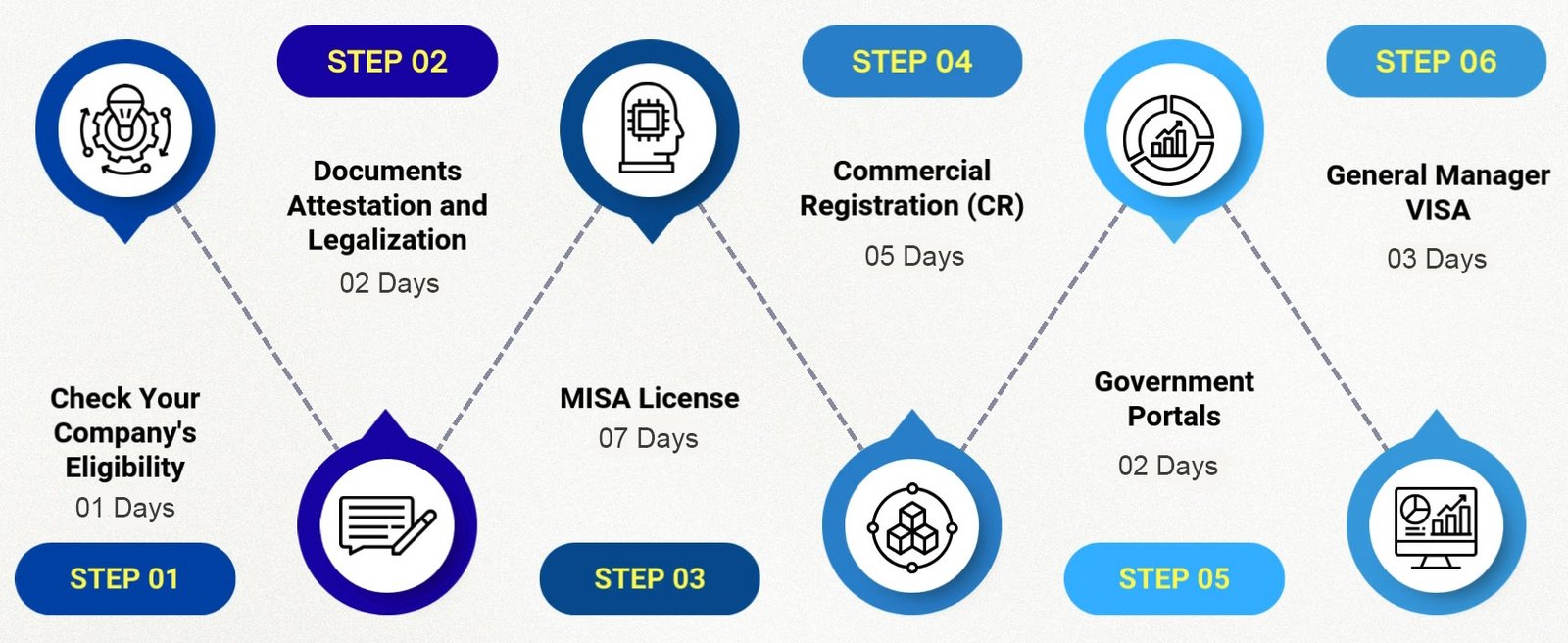
Company Formation Timeline

Processing times vary depending on business activity, documentation, and approvals required from the relevant authorities.
While every business is unique, the overall incorporation process generally follows these stages:

Stage

Estimated Time

Initial Consultation

1 Day

Document Preparation

2–5 Days

MISA Application

Varies by case

Commercial Registration

After approvals

Government Registrations

Several working days

Bank Account Opening

Depends on bank

Operational Setup

Final stage

Documents Required for Company Formation

Although documentation requirements vary depending on the applicant and business activity, companies are commonly required to prepare.
Additional documents may be requested depending on the investment sector and regulatory authority.

Individual Investors

• Valid Passport
• National Identification (if applicable)
• Proof of Address
• Business Activity Details
• Contact Information

Corporate Investors

• Certificate of Incorporation
• Commercial Registration
• Memorandum & Articles of Association
• Board Resolution
• Power of Attorney
• Financial Statements (where applicable)
• Parent Company Information

Common Mistakes During Company Formation

Many business registration delays occur because applicants overlook important regulatory requirements. Some of the most common issues include:

  • Selecting the wrong business activity
  • Choosing an unsuitable legal structure
  • Submitting incomplete documentation
  • Incorrect document legalization
  • Delays in government approvals
  • Missing post-registration compliance requirements
  • Poor planning for employee visas
  • Delayed tax and government registrations

Working with experienced consultants helps reduce processing delays and ensures compliance throughout the incorporation process.

Pexels Fauxels 3184306

Frequently Asked Questions

Depending on the business activity and applicable regulations, many sectors allow foreign investors to establish companies with full foreign ownership.

Not necessarily. Certain business activities permit full foreign ownership, while others may have specific regulatory requirements.

The timeline depends on the business activity, documentation, licensing requirements, and government approvals.

Many stages of the company formation process can be managed remotely, subject to legal documentation and regulatory procedures.

Businesses may also need to complete additional registrations such as tax registration, Chamber of Commerce membership, GOSI, Qiwa, Mudad, municipality licensing, and corporate banking before becoming fully operational.

Scroll to Top