Saudi Arabia has become one of the most attractive markets in the Middle East for foreign investors, entrepreneurs, SMEs, and international companies looking to expand.
With Vision 2030 accelerating economic diversification, the Kingdom is opening new opportunities across consulting, technology, trading, manufacturing, services, real estate, logistics, tourism, healthcare, education, and many other sectors.
But for most foreign investors, the first question is not whether Saudi Arabia has opportunity.
The real question is:
How do I legally and correctly start a business in Saudi Arabia as a foreign investor?
The process is far more structured than many people assume. Saudi Arabia has developed a more investor-friendly ecosystem, and the Ministry of Investment of Saudi Arabia, known as MISA, plays a central role in supporting domestic and foreign investment in the Kingdom. MISA states that it works across government to support investors through their investment journey and build a business-friendly ecosystem. (MISA)
However, while the process has become more streamlined, it still requires the right structure, documentation, licensing, registration, and compliance activation. That is where Elite Consulting Co. helps foreign investors move from interest to execution with clarity, compliance, and confidence.
Why Saudi Arabia Is Attracting More Foreign Investors
Saudi Arabia is no longer viewed only as a regional market. It is becoming a serious global investment destination.
The Kingdom is investing heavily in economic transformation, infrastructure, digitalization, tourism, entertainment, manufacturing, logistics, financial services, and private-sector growth.
For foreign investors, this creates several advantages:
- Access to one of the largest economies in the Middle East
- Strong government focus on investment and private-sector growth
- Expanding demand across B2B and consumer sectors
- Increased openness to international expertise and capital
- Improved digital government services
- More structured pathways for foreign-owned business setup
MISA’s stated mission is to promote Saudi Arabia as a world-class investment destination, attract and retain investors, and expand investment for sustainable national economic growth. (MISA)
For serious investors, this means Saudi Arabia is not just a market to watch. It is a market to enter correctly.
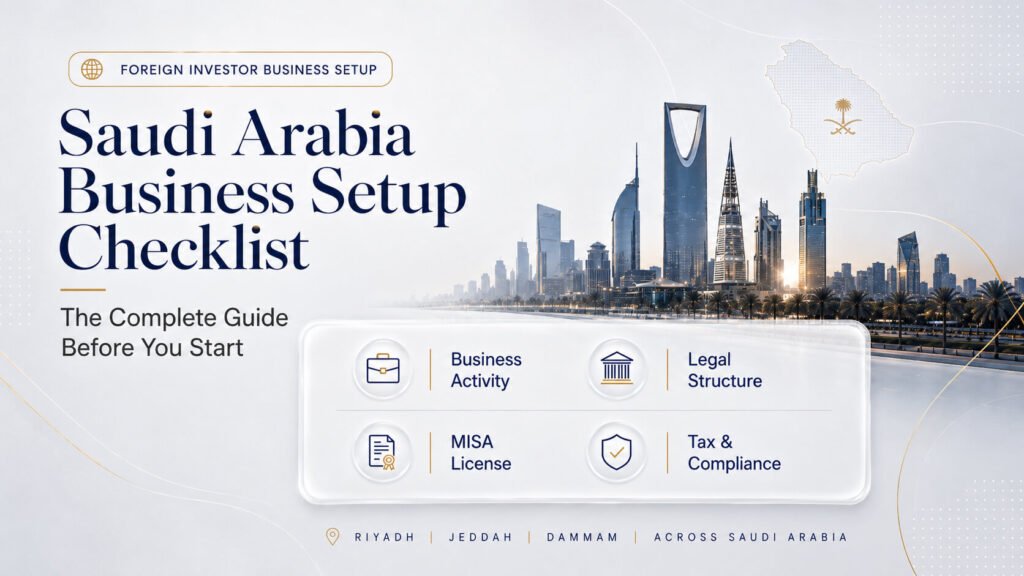
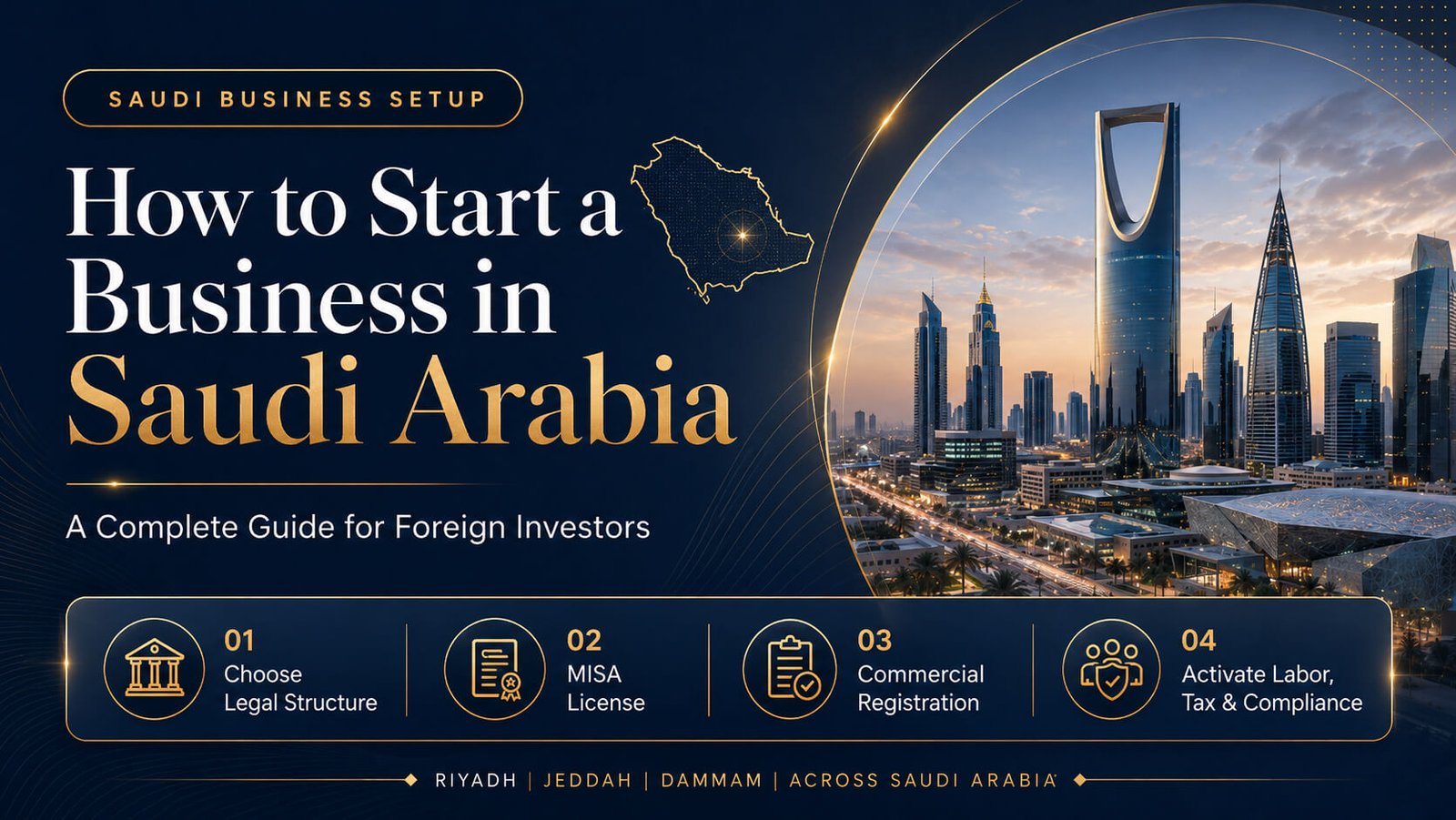
Step 1 — Choose the Right Legal Structure
The first step in starting a business in Saudi Arabia as a foreign investor is selecting the correct legal structure.
This decision affects ownership, liability, licensing, taxation, banking, hiring, operations, and future expansion.
For many foreign investors, one of the most common structures is a Limited Liability Company, also known as an LLC.
An LLC is often preferred because it can provide:
- A structured legal identity
- Limited liability protection
- Operational flexibility
- A recognized company formation route
- A clear framework for shareholders and management
- Suitability for many service, trading, and commercial activities
However, the best structure depends on the investor’s business activity, ownership goals, sector, parent company status, and long-term Saudi market plan.
Some investors may need a branch structure. Others may require a special activity license or sector-specific approval.
This is why Elite Consulting Co. begins with structure before paperwork. Because in Saudi business setup, the wrong structure can create delays, compliance issues, or limitations later.
Step 2 — Apply for the MISA Investment License
For foreign investors, the MISA investment license is one of the most important steps in the company formation journey.
This license gives foreign investors the official authorization to operate in Saudi Arabia under an approved investment activity.
In simple terms:
The MISA license is the foundation of foreign investor business setup in Saudi Arabia.
It confirms that the investor is approved to move forward with business formation as a foreign entity.
The CEO’s original article explains that the MISA license is not just a permit; it is the legal foundation that allows foreign investors to proceed with company formation and, in many sectors, benefit from 100% foreign ownership opportunities under the Kingdom’s evolving investment environment. (LinkedIn)
At this stage, accuracy matters.
The MISA application must be aligned with:
- Business activity
- Ownership structure
- Investor documentation
- Parent company documents, where applicable
- Financial and corporate records
- Intended commercial activity in Saudi Arabia
- Sector-specific requirements
A common mistake foreign investors make is treating the MISA license as a simple form submission.
It is not.
It is a strategic licensing step that should match the investor’s actual business model. Elite Consulting Co. helps clients prepare, structure, and submit the MISA license application correctly so the business setup journey starts on the right foundation.
Step 3 — Prepare Articles of Association and Company Documents
Once the investment license stage is complete, the next step is preparing the company’s constitutional documents.
This usually includes the Articles of Association, which define the company’s ownership, management, capital structure, partner rights, and operating framework.
This stage may include:
- Drafting Articles of Association
- Confirming shareholder details
- Defining management authority
- Confirming capital structure
- Preparing required legal documents
- Coordinating notarization or digital approvals
- Ensuring alignment with Ministry of Commerce requirements
This is where legal clarity becomes important.
The Articles of Association should not only satisfy registration requirements. They should also protect the investor’s commercial interests and create a clean foundation for business operations. Elite Consulting Co. supports investors in preparing documentation that is not only compliant, but also practical for real business execution.
Step 4 — Complete Commercial Registration in Saudi Arabia
After the MISA license and company documentation are ready, the business moves toward Commercial Registration, commonly known as the CR.
The Commercial Registration gives the company its official legal identity in Saudi Arabia.
The Saudi Ministry of Commerce describes commercial registration as an electronic service through the Saudi Business Center platform that allows beneficiaries to start businesses without visiting service centers. The service steps include accessing the platform, selecting commercial registration, filling company information, selecting business activities, submitting the application, paying fees, and receiving the issued commercial registration. (Ministry of Commerce)
This stage typically includes:
- Trade name reservation
- Activity selection
- Address information
- Capital details
- Manager information
- Partner or shareholder approvals
- Submission to the Ministry of Commerce
- CR issuance
Once the CR is issued, the company becomes legally registered.
But this is where many foreign investors misunderstand the process.
A CR means the company is legally created.
It does not always mean the company is fully operational. To operate properly, the company must activate the right government platforms and compliance systems.
Step 5 — Register for Tax, VAT and ZATCA Requirements
After Commercial Registration, businesses must address tax and compliance setup.
This usually includes registration with ZATCA, the Zakat, Tax and Customs Authority.
For businesses subject to VAT, ZATCA provides a VAT registration service where companies can register as VAT-compliant businesses and receive a VAT number once the registration is completed. The service is intended for companies practicing economic activity subject to VAT. (ZATCA)
ZATCA’s VAT registration steps include logging in, going to general services, selecting VAT registration, filling out the registration form, and receiving a VAT certificate notification once complete. (ZATCA)
For foreign investors, this step matters because tax setup affects:
- Invoicing
- Contracts
- Accounting
- Banking
- Compliance
- Import/export activity
- Corporate reporting
- Future audits
Elite Consulting Co. helps clients understand which registrations are required and how to move through the process correctly.
Step 6 — Activate Labor, Immigration, Payroll and Government Portals
Once the company is registered, the next stage is operational activation.
This is one of the most important stages for any foreign investor planning to hire, sponsor employees, manage payroll, or operate properly in Saudi Arabia.
The CEO’s original article highlights the final phase as labor, immigration, payroll, and tax setup, including ZATCA, Qiwa, Muqeem, and other digital platforms for hiring, visa management, employee contracts, and compliance. (LinkedIn)
This stage may include activation or coordination across platforms such as:
- Qiwa
- Muqeem
- GOSI
- Mudad
- ZATCA
- Chamber of Commerce
- National Address
- Saudi Post
- Payroll and employment compliance systems
The Ministry of Commerce notes that after commercial registration is issued, automatic registration may occur with relevant authorities such as the Ministry of Human Resources, ZATCA, GOSI, Saudi Post/National Address, and the Chamber of Commerce. (Ministry of Commerce)
This is where Elite Consulting Co. adds major value.
Because starting a company is not only about receiving documents. It is about becoming ready to operate.
The Practical Roadmap for Foreign Investor Business Setup in Saudi Arabia
Here is the simplified roadmap:
1. Define Your Business Activity
Choose the right activity based on what the company will actually do in Saudi Arabia.
2. Select the Legal Structure
Decide whether an LLC, branch, or another structure is most suitable.
3. Prepare Investor Documents
Collect, translate, attest, and prepare shareholder or parent company documents.
4. Apply for the MISA License
Submit the foreign investor license application under the correct activity.
5. Draft Articles of Association
Prepare company documents and legal structure details.
6. Complete Commercial Registration
Register the company with the Ministry of Commerce and obtain the CR.
7. Activate Tax and Government Portals
Complete ZATCA, VAT where applicable, Qiwa, Muqeem, GOSI, Mudad, Chamber, and National Address setup.
8. Move Toward Operations
Open banking, hire employees, sign contracts, issue invoices, and begin business activity.
Common Mistakes Foreign Investors Should Avoid
Foreign investors often face delays not because Saudi Arabia is impossible to navigate, but because the setup process is approached without proper planning.
Common mistakes include:
- Choosing the wrong legal structure
- Selecting an incorrect business activity
- Submitting incomplete documents
- Misunderstanding MISA licensing requirements
- Assuming CR means full operational readiness
- Delaying ZATCA or VAT registration
- Ignoring Qiwa, Muqeem, GOSI, or Mudad activation
- Not preparing for banking and employment requirements
- Working with providers who only process paperwork without advisory support
Elite Consulting Co. helps investors avoid these issues by managing the setup as a complete market-entry process, not a disconnected paperwork exercise.
Why Choose Elite Consulting Co. for Business Setup in Saudi Arabia?
Foreign investors need more than registration support.
They need a trusted Saudi business setup partner who understands the full journey from licensing to operations.
Elite Consulting Co. supports clients with:
- Foreign investor business setup in Saudi Arabia
- MISA investment license support
- LLC company formation
- Commercial Registration
- Articles of Association
- Tax and VAT registration guidance
- Qiwa, Muqeem, GOSI, Mudad and portal activation
- National Address and Chamber coordination
- Compliance setup
- Market-entry advisory
- End-to-end operational support
What makes Elite Consulting Co. a strong choice is its practical, hands-on understanding of how foreign investors actually enter and operate in Saudi Arabia.
The goal is not only to help clients start a company. The goal is to help them enter Saudi Arabia with clarity, structure, and confidence.
Saudi Arabia Is Open for Serious Foreign Investors
Saudi Arabia’s business environment is moving fast.
The opportunity is real, but investors need the right foundation.
A successful Saudi market entry requires:
- The right business activity
- The right legal structure
- The right MISA license
- The right Commercial Registration
- The right tax and portal setup
- The right advisory partner
With proper planning, foreign investors can move from initial concept to a legally registered and operational Saudi entity in a clear, structured way. Elite Consulting Co. helps make that journey simpler, faster, and more reliable.
Ready to Start Your Business in Saudi Arabia?
Whether you are an entrepreneur, SME, international company, or foreign investor planning to enter the Saudi market, Elite Consulting Co. can help you understand the right setup route and manage the process from start to operational readiness.
Speak to Elite Consulting Co. today to start your business in Saudi Arabia with clarity, compliance, and confidence.
FAQ
How can a foreign investor start a business in Saudi Arabia?
A foreign investor usually starts by choosing the right legal structure, preparing documents, applying for a MISA investment license, completing Commercial Registration, and activating tax, labor, immigration, and government portal requirements.
What is a MISA license in Saudi Arabia?
A MISA license is an investment license issued through the Ministry of Investment of Saudi Arabia. It allows foreign investors to proceed with approved business activity and company formation in Saudi Arabia.
Can foreign investors own 100% of a company in Saudi Arabia?
In many sectors, foreign investors may be able to own 100% of a Saudi company, subject to the approved activity, licensing conditions, and applicable regulations. Some sectors may require additional approvals or restrictions.
What is the best company structure for foreign investors in Saudi Arabia?
Many foreign investors choose a Limited Liability Company, or LLC, because it offers structure, flexibility, and limited liability. However, the best structure depends on the business activity, ownership model, and market-entry strategy.
What is Commercial Registration in Saudi Arabia?
Commercial Registration, or CR, is the official registration that gives a business its legal identity in Saudi Arabia. It is issued through the Ministry of Commerce process.
Is a Saudi company fully operational after getting the CR?
Not always. After the CR is issued, the company may still need ZATCA, VAT where applicable, Qiwa, Muqeem, GOSI, Mudad, National Address, Chamber, and other operational activations.
Why should foreign investors work with a Saudi business setup consultant? A Saudi business setup consultant helps investors choose the right structure, prepare documents, apply for the correct license, reduce delays, activate government portals, and avoid compliance mistakes.