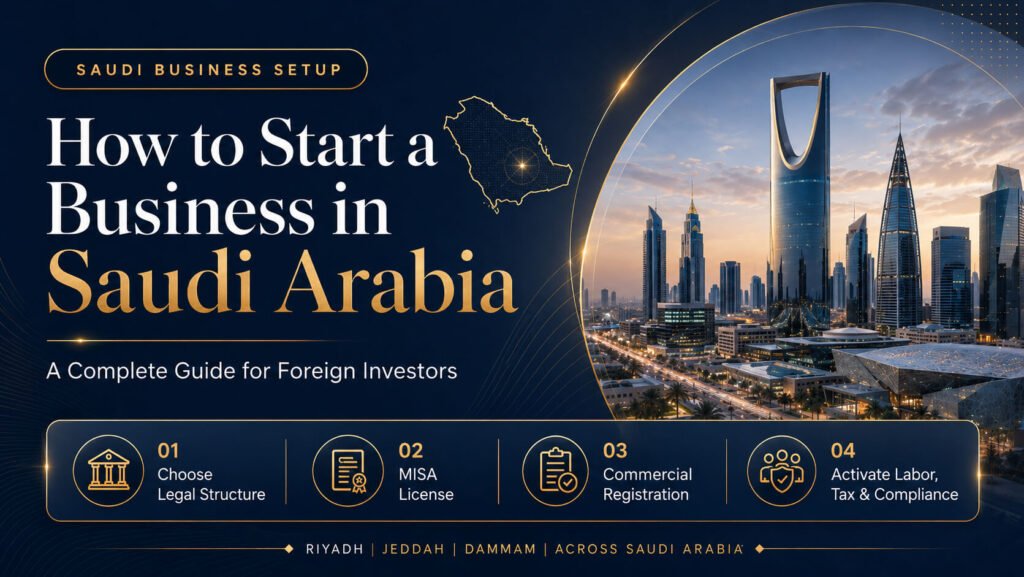

Saudi Arabia is rapidly transforming into one of the world’s most attractive business destinations. With Vision 2030 driving unprecedented economic diversification, the Kingdom has opened its doors to foreign investors like never before. Whether you are an entrepreneur, a multinational corporation, or a small business owner looking to expand into the Middle East, this comprehensive guide walks you through everything you need to know about starting a business in Saudi Arabia in 2026.
The Kingdom of Saudi Arabia has undergone a remarkable economic transformation over the past decade. Under the leadership of Vision 2030, the Saudi government has implemented sweeping reforms to diversify the economy away from oil dependence and create a vibrant, business-friendly environment. These reforms have resulted in simplified company registration processes, the introduction of 100% foreign ownership in most sectors, world-class infrastructure development, and the creation of special economic zones with attractive incentives. For any investor looking at the Middle East market, Saudi Arabia now represents the single most compelling opportunity.
Why Start a Business in Saudi Arabia?
Saudi Arabia offers a unique combination of strategic advantages that make it an ideal destination for business setup and growth. The Kingdom’s strategic location at the crossroads of Europe, Asia, and Africa provides unparalleled access to three continents and over two billion consumers. This geographic advantage is complemented by world-class infrastructure including modern ports, airports, and logistics networks that facilitate seamless trade and transportation.
Vision 2030 has unlocked massive government investment across non-oil sectors including technology, healthcare, tourism, renewable energy, entertainment, and logistics. The Saudi government has allocated trillions of dollars toward infrastructure projects, giga-projects like NEOM and the Red Sea Project, and economic cities that are creating unprecedented business opportunities. To explore which sectors offer the most potential, read our guide on the best industries to invest in Saudi Arabia in 2026. The regulatory environment has been completely modernized with streamlined company registration, 100% foreign ownership permitted in most sectors, simplified visa processes, and competitive corporate tax rates with zero personal income tax. Additionally, over 60 percent of the Saudi population is under the age of 35, providing businesses with access to a young, ambitious, and increasingly well-educated talent pool that is eager to work with international companies.
Business Structures Available in Saudi Arabia
Choosing the right business structure is one of the most critical decisions you will make when entering the Saudi market. Each structure offers different benefits in terms of liability protection, ownership flexibility, tax treatment, and operational scope. For a detailed comparison of the two most popular structures, see our guide on LLC vs Branch Office in Saudi Arabia. Understanding these options thoroughly will help you select the structure that best aligns with your business objectives and risk tolerance.
1. Limited Liability Company (LLC)
The Limited Liability Company is by far the most popular choice for foreign investors establishing a presence in Saudi Arabia. An LLC is a separate legal entity that provides limited liability protection to its shareholders, meaning personal assets are generally protected from business liabilities. This structure requires a minimum of one shareholder with no maximum limit, and importantly, there is no minimum capital requirement for most business activities under current regulations. Foreign investors can own 100 percent of an LLC through a MISA investment license, giving them complete control over operations and strategic direction. The LLC structure is suitable for trading, services, manufacturing, and contracting activities, making it the most versatile option for most businesses entering the Saudi market.
2. Branch Office
A branch office allows a foreign company to operate in Saudi Arabia under the parent company’s name and legal identity. Unlike an LLC, a branch office is not a separate legal entity, which means the parent company bears full liability for all branch obligations. Branch offices offer full foreign ownership and can be established more quickly than an LLC in many cases, typically taking three to six weeks. However, branch offices are generally limited to the same activities as the parent company and may face restrictions on trading activities. This structure is particularly suitable for large multinational corporations, companies seeking government contracts, or businesses testing the Saudi market before making a larger commitment.
3. Regional Headquarters (RHQ)
The Regional Headquarters program was launched as a strategic initiative under Vision 2030 to encourage multinational corporations to base their regional operations in Saudi Arabia rather than in competing regional hubs. The RHQ program offers exceptionally attractive incentives including a 30-year corporate income tax exemption, a 30-year withholding tax exemption on dividends, interest, and royalties paid to the parent company, no Saudization requirements for the first three years, and streamlined visa and immigration processing for RHQ employees and their families. To qualify, the parent company must be a multinational with operations in at least two countries, maintain a minimum capital of SAR 10 million, employ at least 15 employees within the first year, and maintain a physical office in Saudi Arabia. For qualifying multinationals, the RHQ structure offers the most favorable tax treatment available in the region.
4. Sole Proprietorship
A sole proprietorship is the simplest business structure available in Saudi Arabia, suitable for individual entrepreneurs, freelancers, and consultants who wish to operate independently. This structure offers full ownership and control but comes with unlimited personal liability, meaning personal assets are at risk if the business incurs debts or legal obligations. Sole proprietorships are relatively straightforward to establish but are generally not recommended for businesses with significant liability exposure or those planning to scale operations substantially.
5. Joint Venture
A joint venture involves a partnership between a foreign investor and a Saudi partner or company. While 100 percent foreign ownership is now permitted in most sectors, joint ventures remain common in regulated industries where Saudi partnership is required by law, or in situations where a local partner brings valuable market knowledge, relationships, or resources. Joint ventures can be structured as either contractual arrangements or as separate corporate entities, and the terms of profit sharing, management control, and exit arrangements should be clearly documented in a comprehensive joint venture agreement.
Foreign Ownership Rules and Regulations
The Saudi Arabian General Investment Authority, now operating as the Ministry of Investment of Saudi Arabia (MISA), is the primary government body governing foreign investment in the Kingdom. Under Vision 2030 reforms, 100 percent foreign ownership is now permitted in the vast majority of economic sectors, representing a fundamental shift from the previous requirement for Saudi partners. However, certain industries remain on what is known as the “negative list,” including oil exploration and production, military and defense industries, security services, real estate development in Mecca and Medina, and certain printing and publishing activities. These restricted sectors require Saudi partnership or are reserved exclusively for Saudi nationals.
To invest in Saudi Arabia as a foreign entity, you must obtain a MISA investment license before proceeding with commercial registration. The licensing process involves submitting a detailed application along with supporting documentation including a business plan or feasibility study, financial statements, passport copies of shareholders and directors, and proof of financial capability. MISA reviews applications based on the economic contribution of the proposed investment, its alignment with national development priorities, and the investor’s financial and technical capacity.
Step-by-Step Business Registration Process
Step 1: Obtain a MISA Investment License
The first and most critical step is securing an investment license from MISA. This involves completing a detailed application form on the Invest Saudi portal, submitting a comprehensive business plan or feasibility study that demonstrates the economic value of your proposed investment, providing copies of passports and identification documents for all shareholders and directors, providing proof of financial capability through bank statements or audited financial statements, and preparing Articles of Association if establishing an LLC. The processing time for a MISA license application is typically five to ten business days, though this can vary depending on the complexity of the proposed business activities and the completeness of the submitted documentation.
Step 2: Register with the Ministry of Commerce
Once your MISA investment license is approved, the next step is to register your company with the Ministry of Commerce (MC) to obtain your Commercial Registration (CR). This involves submitting your MISA license, notarized Articles of Association (for LLCs), a lease agreement for your registered office address, and the completed registration application. The CR is the foundational document that officially recognizes your company as a legal entity authorized to conduct business in Saudi Arabia. Processing typically takes three to five business days.
Step 3: Obtain Chamber of Commerce Membership
All companies operating in Saudi Arabia must register with the local Chamber of Commerce in their city of operation. Chamber membership provides access to certificate of origin issuance, legal authentication services, trade information, and networking opportunities. This registration typically takes one to two business days.
Step 4: Register for Tax with ZATCA
Register with the Zakat, Tax and Customs Authority (ZATCA) for corporate income tax, VAT registration if your turnover exceeds SAR 375,000 annually, and Zakat registration if applicable. You will receive a Tax Identification Number (TIN) that must be included on all tax invoices and correspondence with tax authorities. Processing takes five to ten business days.
Step 5: Register with GOSI
All companies must register with the General Organization for Social Insurance (GOSI) to enroll employees in the national social insurance system. Monthly contributions include 11 percent of salary for Saudi employees (plus 2 percent for unemployment insurance) and 2 percent for foreign employees (occupational hazard coverage only). Registration takes one to two business days.
Step 6: Register on Qiwa Platform
Register your company on the Qiwa platform managed by the Ministry of Human Resources and Social Development (MHRSD). Qiwa is the central digital platform for all labor market compliance matters including work permit applications, employee record management, and Saudization monitoring. For detailed guidance on employer obligations, see our MHRSD Compliance Guide for Employers. Registration takes one to two business days.
Step 7: Open a Corporate Bank Account
Opening a corporate bank account in Saudi Arabia requires your Commercial Registration, MISA license, Articles of Association, board resolution authorizing account opening, and identification documents for all authorized signatories. This process typically takes five to fifteen business days depending on the bank and the completeness of your documentation.
Step 8: Apply for Employee Visas and Iqamas
Once your company is fully registered, you can sponsor employees by applying for work permits through Qiwa, obtaining entry visas for overseas hires, completing medical examinations and fingerprinting, and issuing Iqama residence permits. This process typically takes ten to thirty business days depending on the volume of applications. For a complete timeline overview, visit our guide on how long company formation takes in Saudi Arabia.
Costs of Starting a Business in Saudi Arabia
The total cost of establishing a business in Saudi Arabia varies significantly depending on your chosen business structure, the nature of your business activities, the location of your office, and the complexity of your setup requirements. For a detailed breakdown of all expenses, see our comprehensive guide on the cost to start a business in Saudi Arabia. A basic LLC setup with a virtual office can cost approximately SAR 30,000 to 50,000, while a full setup with employees and physical office space can range from SAR 100,000 to 250,000 or more. Key cost components include MISA license fees ranging from SAR 2,000 to 8,000 depending on the license type, Commercial Registration fees of SAR 1,500 to 3,500, Chamber of Commerce membership of SAR 2,000 to 5,000, legal and consulting fees of SAR 10,000 to 50,000, notarization and translation services of SAR 2,000 to 5,000, annual office space costs ranging from SAR 6,000 for a virtual office to SAR 150,000 or more for a premium physical location, and visa and Iqama processing costs of approximately SAR 5,000 to 15,000 per employee.
Government Approvals Required
Depending on your specific business activities, you may require additional approvals from sector-specific regulatory bodies. Businesses in the healthcare sector require approval from the Ministry of Health, food and drug-related activities require Saudi Food and Drug Authority (SFDA) licensing, aviation activities need General Authority of Civil Aviation (GACA) approval, educational institutions require Ministry of Education licensing, and financial services companies must be licensed by the Saudi Central Bank (SAMA). It is essential to research the specific regulatory requirements for your industry and factor in the additional processing time for sector-specific approvals.
Ongoing Compliance Requirements
Starting a business in Saudi Arabia is only the beginning. Ongoing compliance is essential to maintain good standing and avoid penalties. Annual Commercial Registration renewal must be completed before expiration each year. VAT returns must be filed monthly or quarterly depending on your turnover, with corporate income tax returns due annually by June 30. Monthly GOSI contributions must be paid before the 15th of each month without fail. Qiwa records must be kept current with all employee information, and Saudization levels must be maintained to avoid visa processing restrictions. For a full compliance framework, see our Saudi Business Compliance and Government Regulations Guide. To avoid costly errors, also read about common mistakes foreign investors make in Saudi Arabia. Annual audited financial statements must be prepared by a licensed auditor and submitted to ZATCA. Additionally, all business licenses including the MISA investment license must be renewed before their expiration dates.
FAQs
Can a foreigner own 100% of a company in Saudi Arabia?
Yes. Under Vision 2030 reforms, 100 percent foreign ownership is permitted in most sectors through a MISA investment license.
What is the minimum capital for an LLC?
There is no minimum capital requirement for most business activities, though regulated activities may have specific capital requirements.
How long does company registration take?
The full process typically takes 30 to 75 days depending on business activity complexity and documentation readiness. See our detailed company formation timeline guide for a week-by-week breakdown.
Do I need a local partner?
For most sectors, no. 100 percent foreign ownership is now standard. Some regulated industries on the negative list still require a Saudi partner.
What is the corporate tax rate?
Corporate income tax is 20 percent for foreign-owned companies. Zakat at 2.5 percent applies to Saudi and GCC shareholders.
Get Expert Help
Starting a business in Saudi Arabia involves navigating complex regulations and multiple government agencies. Elite Consulting Co. provides end-to-end company formation services from MISA licensing to visa processing and compliance support. Our experienced team has helped hundreds of international investors establish successful businesses in the Kingdom.
Contact us today for a free consultation and let our team of experts fast-track your entry into the Saudi market.