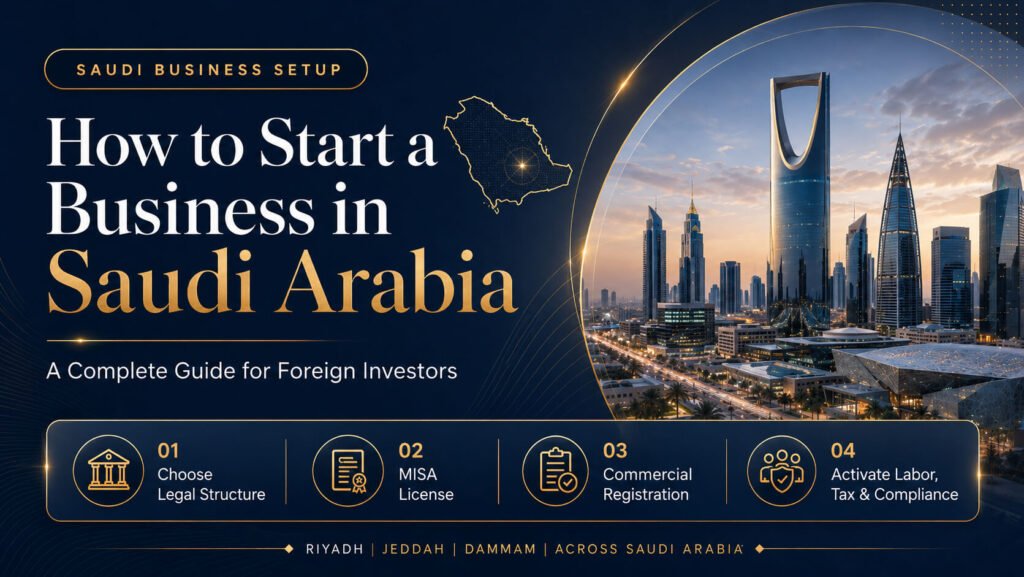

Saudi Arabia has emerged as the premier destination for foreign direct investment in the Middle East. With Vision 2030 driving unprecedented pro-business reforms, the Kingdom offers a streamlined and transparent path for international investors to establish a presence in the largest economy in the Arab world. This comprehensive guide covers everything foreign investors need to know about company formation in Saudi Arabia, from choosing the right legal structure to understanding tax obligations and compliance requirements. For a broader overview, also read our Complete Guide to Starting a Business in Saudi Arabia.
The scale of opportunity in Saudi Arabia is difficult to overstate. The Kingdom is undertaking the most ambitious economic transformation program in modern history, with trillions of dollars being invested across infrastructure, technology, healthcare, tourism, renewable energy, and logistics. The population exceeds 35 million people with a median age of under 30 years, creating a dynamic consumer market and a growing workforce. Saudi Arabia is also a member of the G20 and enjoys preferential trade access to markets across the Middle East, Africa, and Asia. For any international investor seeking growth opportunities in the coming decade, Saudi Arabia represents the single most compelling market in the region.
Why Choose Saudi Arabia for Company Formation?
Foreign investors are increasingly choosing Saudi Arabia for a combination of compelling reasons that together create an unmatched business environment. The Kingdom offers the largest economy in the Middle East with a GDP exceeding one trillion dollars and one of the fastest growth rates among G20 nations. Vision 2030 has unlocked investment opportunities across every major sector, with the government actively seeking foreign partners to develop new industries and modernize existing ones. The ease of doing business has improved dramatically, with Saudi Arabia ranking among the top improvers globally in the World Bank’s Doing Business report. Company registration processes that once took months can now be completed in weeks, and the legal framework for foreign investment has been completely overhauled to provide clarity, protection, and transparency.
The strategic location of Saudi Arabia at the crossroads of Europe, Asia, and Africa provides businesses with access to markets containing over two billion consumers. World-class infrastructure including modern ports, airports, highways, and digital networks supports efficient business operations. The tax environment is highly competitive with a corporate income tax rate of 20 percent, zero personal income tax, and special economic zones offering enhanced incentives including tax holidays and customs duty exemptions. The young and growing population provides access to a dynamic talent pool, and the government has invested heavily in education and vocational training to develop a skilled workforce for the future economy.
LLC vs Branch Office: Choosing the Right Structure
Selecting the appropriate legal structure is one of the most consequential decisions in the company formation process. The choice between an LLC, branch office, or other structure affects liability exposure, tax obligations, operational flexibility, and long-term strategic options. For a detailed side-by-side comparison, see our guide on LLC vs Branch Office in Saudi Arabia. Understanding the advantages and limitations of each structure is essential for making an informed decision that aligns with your business objectives.
Limited Liability Company (LLC) in Detail
The Limited Liability Company is the most popular and versatile structure for foreign investors in Saudi Arabia. An LLC is a separate legal entity with its own rights and obligations, providing shareholders with protection against personal liability for business debts and obligations. This means that in most circumstances, shareholders’ personal assets are protected if the company faces financial difficulties or legal claims. The LLC structure offers maximum flexibility in terms of business activities, allowing companies to engage in trading, services, manufacturing, contracting, and consulting activities under a single license.
One of the most significant advantages of the LLC structure is that there is no minimum capital requirement for most business activities under current regulations. This represents a major improvement from previous requirements and makes Saudi Arabia accessible to entrepreneurs and smaller investors who may not have large capital reserves. The LLC can have between one and fifty shareholders, and 100 percent foreign ownership is permitted through a MISA investment license. The LLC is required to maintain a physical office in Saudi Arabia, prepare annual audited financial statements, appoint a licensed auditor, and hold annual general meetings. Despite these requirements, the LLC remains the structure of choice for the vast majority of foreign investors due to its combination of liability protection, ownership flexibility, and operational versatility.
Branch Office in Detail
A branch office allows a foreign company to establish a presence in Saudi Arabia as an extension of the parent company rather than as a separate legal entity. This means the branch operates under the parent company’s name and legal identity, and the parent company bears full responsibility for all branch obligations and liabilities. The branch office structure is generally faster to establish than an LLC, with typical setup times of three to six weeks compared to four to eight weeks for an LLC.
The branch office does not require separate capital allocation, as the parent company’s financial strength serves as the capital base. However, some regulated activities may require the parent company to demonstrate minimum capital thresholds or provide guarantees. Branch offices are generally limited to the same business activities as the parent company and may face additional restrictions on trading activities. The branch must still register with all relevant government agencies including MISA, the Ministry of Commerce, ZATCA, GOSI, and MHRSD, and must maintain proper accounting records and file tax returns. The branch office structure is particularly well-suited for large corporations, companies seeking government contracts that require a local presence, and businesses testing the Saudi market before deciding on a larger commitment.
Regional Headquarters (RHQ)
The Regional Headquarters program represents one of the most attractive investment incentives offered anywhere in the Middle East. Designed to position Saudi Arabia as the premier hub for regional management and coordination, the RHQ program offers qualifying multinational corporations a comprehensive package of benefits including a 30-year exemption from corporate income tax, a 30-year exemption from withholding tax on dividends, interest, and royalties paid to the parent company, and no Saudization requirements for the first three years of operations.
To qualify for RHQ status, the parent company must be a multinational corporation with operations in at least two countries outside Saudi Arabia. The RHQ must maintain a minimum capital of SAR 10 million, employ at least 15 full-time employees within the first year of operations, and maintain a physical office suitable for regional management functions. The RHQ program is exclusively available to multinational corporations with significant regional operations and is not suitable for smaller businesses or startups.
Obtaining a MISA Investment License
The Ministry of Investment of Saudi Arabia (MISA) is the gateway for foreign investment in the Kingdom. Obtaining a MISA investment license is the first formal step in the company formation process and requires careful preparation and documentation. The type of license required depends on the proposed business activities, with service licenses for consulting and professional services, industrial licenses for manufacturing, commercial licenses for trading and distribution, agricultural licenses for farming projects, and real estate licenses for development activities.
The application process begins with document preparation including a completed application form, a comprehensive feasibility study or business plan that demonstrates the economic contribution of the proposed investment, audited financial statements for the past two years (for corporate applicants), passport copies of all shareholders and directors, and a board resolution authorizing the investment. The application is submitted online through the Invest Saudi portal along with the applicable processing fee. MISA reviews the application based on the investment’s alignment with national development priorities, the investor’s financial and technical capacity, and the projected economic impact. Approval typically takes five to ten business days for straightforward applications, though more complex projects may require additional review time.
Tax Obligations for Foreign-Owned Companies
Understanding the tax implications of your chosen business structure is essential for financial planning and compliance. For detailed guidance on VAT obligations, see our ZATCA VAT Registration Guide. Foreign-owned companies in Saudi Arabia are subject to corporate income tax at a rate of 20 percent on the foreign shareholders’ share of net profits. The Saudi or GCC shareholders’ share of profits is subject to Zakat at a rate of 2.5 percent of the Zakat base rather than corporate income tax. This dual system requires careful tax planning and accurate record keeping to ensure proper allocation of profits between foreign and Saudi shareholders.
Value Added Tax at a rate of 15 percent applies to most goods and services supplied in Saudi Arabia. Businesses with annual taxable turnover exceeding SAR 375,000 must register for VAT with ZATCA and file returns on a monthly or quarterly basis depending on turnover volume. Withholding tax must be deducted and remitted on payments made to non-resident entities, with rates varying by payment type including 5 percent on dividends, 15 percent on royalties, 5 percent on interest, 20 percent on management fees, and 15 percent on technical services. Transfer pricing regulations require related-party transactions to be conducted at arm’s length with proper documentation maintained.
How Elite Consulting Co. Can Help
Navigating the company formation process in Saudi Arabia requires expertise across multiple regulatory domains. For a step-by-step walkthrough, see our guide on how to register a company in Saudi Arabia. Elite Consulting Co. provides comprehensive support services including MISA license procurement, company registration and CR issuance, corporate bank account setup, visa and immigration processing for employees, and ongoing compliance management for tax, labor, and regulatory obligations. Our team of experienced professionals understands the nuances of Saudi business regulations and maintains strong working relationships with government agencies across the Kingdom.
Schedule your free consultation today and let us handle the complexities of Saudi company formation while you focus on growing your business. For more information on costs, read our guide on the cost to start a business in Saudi Arabia, and for timeline details, see how long company formation takes. Our dedicated case managers will guide you through every step of the process and ensure your company is established correctly and efficiently.