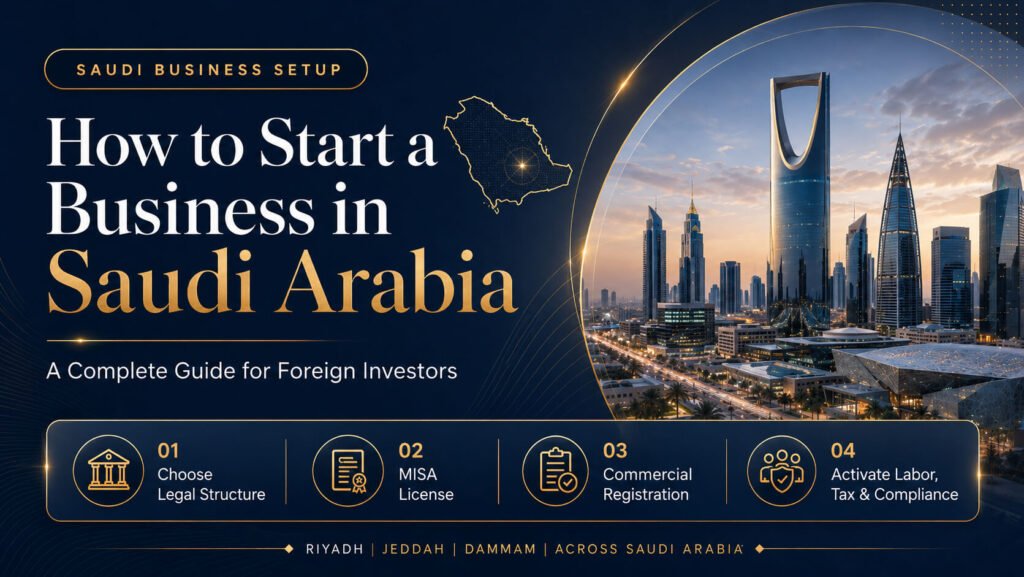

Operating a business in Saudi Arabia requires navigating a complex but well-defined regulatory landscape that has been significantly modernized under Vision 2030. From labor law compliance to tax obligations, social insurance contributions, and industry-specific licensing requirements, staying compliant is essential for avoiding penalties, maintaining good standing, and ensuring uninterrupted business operations. This comprehensive guide covers the key regulatory bodies, compliance requirements, and best practices for businesses operating in the Kingdom of Saudi Arabia.
The regulatory environment in Saudi Arabia has undergone a fundamental transformation in recent years. Government agencies have digitized their services, streamlined processes, and introduced unified digital platforms that simplify compliance for businesses. The establishment of the Qiwa platform for labor compliance, the Fatora system for electronic invoicing, and the integration of government services through the Absher business portal have made it significantly easier for companies to meet their regulatory obligations. However, the regulatory landscape remains complex with multiple agencies having overlapping jurisdiction, and non-compliance can result in significant penalties, operational restrictions, and in severe cases, business suspension.
Key Regulatory Bodies in Saudi Arabia
Ministry of Human Resources and Social Development (MHRSD)
The Ministry of Human Resources and Social Development is the primary authority governing labor market regulation, employment policies, and social development programs in Saudi Arabia. MHRSD is responsible for enforcing Saudi labor law, managing the Qiwa digital platform that serves as the central hub for all employer-employee compliance matters, implementing the Saudization (Nitaqat) program that requires companies to employ Saudi nationals, issuing and renewing work permits for foreign employees, regulating employment contracts to ensure they meet legal standards, and overseeing occupational safety and health standards in the workplace. Every employer in Saudi Arabia must establish and maintain a compliant relationship with MHRSD through the Qiwa platform. For detailed guidance, see our MHRSD Compliance Guide for Employers.
Zakat, Tax and Customs Authority (ZATCA)
The Zakat, Tax and Customs Authority is the consolidated tax and customs authority responsible for all fiscal matters in the Kingdom. ZATCA administers corporate income tax on foreign-owned companies, Value Added Tax at the standard rate of 15 percent, Zakat assessment and collection from Saudi and GCC-owned businesses, customs duties on imported goods, and transfer pricing compliance for related-party transactions. For complete VAT guidance, see our ZATCA VAT Registration Guide. ZATCA has implemented a comprehensive digital transformation program that includes mandatory electronic invoicing through the Fatora system, automated tax return filing, and real-time data exchange with businesses. Non-compliance with ZATCA requirements can result in substantial penalties, interest charges, and in serious cases, criminal prosecution.
General Organization for Social Insurance (GOSI)
The General Organization for Social Insurance manages the national social insurance system that provides coverage for employees working in Saudi Arabia. GOSI administers occupational hazard insurance covering work-related injuries and illnesses for all employees regardless of nationality, annuity contributions that provide retirement benefits for Saudi employees, unemployment insurance (SANED) for Saudi employees who lose their jobs through no fault of their own, and end-of-service benefit calculations. Monthly GOSI contributions must be paid before the 15th of each month, with employer contributions for Saudi employees totaling 11 percent of salary plus 2 percent for unemployment insurance, and employer contributions for foreign employees at 2 percent of salary for occupational hazard coverage only.
Ministry of Investment of Saudi Arabia (MISA)
MISA is the government authority responsible for regulating and promoting foreign investment in Saudi Arabia. MISA issues investment licenses to foreign investors, develops investment policies and regulations that align with Vision 2030 objectives, provides investor facilitation and aftercare services to support established investors, and monitors compliance with investment license conditions. All foreign-owned companies must maintain a valid MISA investment license and renew it annually or as specified in the license terms.
Ministry of Commerce (MC)
The Ministry of Commerce regulates commercial activities in Saudi Arabia including company incorporation and commercial registration, trademark registration and intellectual property protection, consumer protection and fair trade practices, and commercial dispute resolution. The Ministry of Commerce maintains the commercial registry where all companies must be registered, and issues Commercial Registration certificates that serve as the foundational legal document for any business operating in the Kingdom.
The Qiwa Platform: Your Digital Compliance Hub
Qiwa is the unified digital platform developed and managed by MHRSD that serves as the central hub for all labor market compliance matters. Every employer in Saudi Arabia must register on Qiwa and use it as the primary platform for managing employee relationships with government authorities. The platform enables employers to register new employees and maintain comprehensive employee records including contracts, qualifications, and employment history. Work permit applications and renewals for foreign employees are submitted and tracked through Qiwa, and the platform provides real-time monitoring of Saudization (Nitaqat) compliance status with early warning alerts when corrective action is needed.
Professional accreditation requests for regulated professions are managed through Qiwa, and the platform allows employers to submit payroll data and employment information required for government analysis and policy development. Registration on Qiwa is straightforward and begins with creating an account on the Qiwa website, verifying company information using the Commercial Registration number, registering the establishment with complete company details, adding employee records for all current and new employees, and beginning to submit work permit applications and manage compliance tasks through the platform’s intuitive interface.
Saudization (Nitaqat) Program
Saudization is a cornerstone of Saudi Arabia’s national employment policy, implemented through the Nitaqat program that classifies companies based on the percentage of Saudi nationals they employ relative to their total workforce and sector-specific targets. The program applies to all companies with six or more employees and classifies them into color bands that determine their visa processing privileges and operational flexibility. For a complete overview, see our Saudization Nitaqat Guide for New Businesses.
Companies classified in the Platinum band, representing the top 25 percent of companies in their sector, enjoy full benefits including unlimited visa processing, priority government services, and simplified work permit renewals. High Green companies performing above their sector target receive enhanced benefits with simplified visa processing and few restrictions. Medium Green companies meeting their target receive standard processing benefits. Low Green companies performing below target face limited visa issuance and operational restrictions. Yellow band companies significantly below target face severe restrictions on visa issuance and limited operational capacity. Red band companies with critically low Saudization levels face a complete suspension of visa issuance, possible financial penalties, and in extreme cases, business closure orders.
Achieving and maintaining strong Nitaqat compliance requires a strategic approach to talent acquisition and workforce development. Successful companies develop comprehensive Saudi talent attraction strategies, partner with universities and technical colleges for graduate recruitment, offer competitive compensation packages that attract Saudi professionals, invest in training and development programs that build Saudi employee skills and career progression, participate in government-supported programs like Tamheer that subsidize Saudi employee salaries, and continuously monitor their Nitaqat status and take corrective action before their classification deteriorates.
Labor Law Compliance Requirements
Saudi labor law establishes comprehensive requirements for employer-employee relationships that all companies must follow. Employment contracts must be in writing and in the Arabic language, containing detailed terms including job title and description, salary and all benefits, working hours not exceeding eight hours per day or forty-eight hours per week (reduced to six hours per day during Ramadan), overtime compensation at one and a half times the normal hourly rate, annual leave of twenty-one days increasing to thirty days after five years of service, sick leave with full pay for thirty days followed by seventy-five percent pay for an additional sixty days, and notice periods ranging from thirty to ninety days depending on the contract type and duration.
All foreign employees must hold a valid work permit issued by MHRSD and an Iqama residence permit that serves as their official identification document in Saudi Arabia. Work permits are typically valid for one to two years and must be renewed before expiration to avoid penalties and disruption to the employee’s legal status. End-of-service benefits must be calculated and paid to employees upon termination of employment, with employees who have served less than five years receiving half a month’s salary for each year of service, and employees who have served five or more years receiving one full month’s salary for each year of service beyond the first five years.
Annual Compliance Checklist
Maintaining compliance throughout the year requires systematic attention to recurring obligations. Monthly obligations include GOSI contributions due before the 15th of each month, VAT returns and payments for monthly filers, and accurate payroll processing and record keeping. Quarterly obligations include VAT returns and payments for quarterly filers and withholding tax filing and remittance. Annual obligations include Commercial Registration renewal before the expiry date, MISA investment license renewal as required, preparation and filing of audited financial statements with ZATCA, corporate income tax return filing by June 30, Zakat return filing for Saudi and GCC shareholders, review of Nitaqat compliance status and corrective action if needed, work permit renewals for all foreign employees, updating employee records on Qiwa, and renewal of municipality license and any industry-specific permits.
How Elite Consulting Co. Supports Your Compliance
Managing the full spectrum of compliance requirements in Saudi Arabia is a significant undertaking that requires dedicated expertise and attention to detail. For new investors, our Complete Guide to Starting a Business in Saudi Arabia provides a helpful overview of all regulatory requirements. Elite Consulting Co. offers comprehensive compliance support services that give business owners peace of mind and ensure their operations remain fully compliant with all applicable regulations. Our services include full management of HR and MHRSD compliance through the Qiwa platform, professional bookkeeping with accurate VAT and Zakat filing, comprehensive license management with renewal tracking and processing, Saudization consulting and Nitaqat compliance strategy development, and regular compliance audits to identify and address potential issues before they become problems.
Contact us today to discuss your compliance needs and learn how Elite Consulting Co. can help you maintain a compliant and successful business operation in Saudi Arabia.