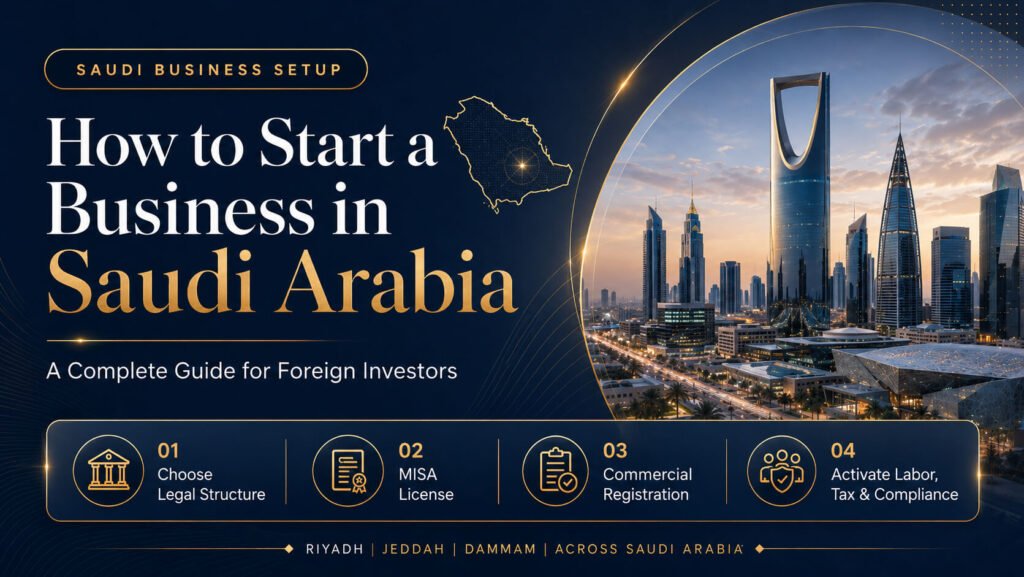

Quick Answer
To launch a business in Saudi Arabia in 2026, foreign investors should complete seven key steps: choose the right business activity, select the correct legal structure, confirm investment and licensing requirements, prepare documentation, register the company, activate tax and government portals, and prepare for operational readiness. Each step affects how smoothly a company can move from idea to legal setup, then from registration to actual market operations.
Why Saudi Arabia Is Becoming a Serious Expansion Market
Saudi Arabia is no longer just a destination for large multinationals. It is becoming a serious growth market for founders, foreign investors, family businesses, SMEs and international companies looking for new regional opportunities.
The Kingdom’s economic transformation has opened new demand across sectors such as technology, construction, consulting, logistics, retail, manufacturing, tourism, real estate services, healthcare, food services and professional services.
For many foreign investors, the opportunity is clear.
The challenge is not whether Saudi Arabia has business potential.
The real challenge is knowing how to enter the market correctly.
Many investors begin with excitement. They identify a product, service or partnership opportunity. They speak to potential clients. They hear that foreign companies can now enter the Saudi market more easily than before. Then they rush toward company registration.
That is where delays often begin.
Saudi business setup is not only about filling out forms. It is about choosing the right activity, matching it with the right license, preparing the right documents, understanding compliance obligations and ensuring that the company can actually operate after registration.
A company may be registered, but not fully ready.
A license may be issued, but not aligned with the business model.
A bank account may be needed, but documentation may not be complete.
An investor may have a business idea, but the selected activity may not support the services they plan to offer. That is why a proper Saudi launch checklist matters.
Step 1: Choose the Right Business Activity
The first major decision is the business activity.
This is one of the most important steps in Saudi company formation because the activity you select can influence licensing requirements, approvals, documentation, ownership structure, banking, tax registration and future operations.
A business activity is not just a label. It tells the authorities what your company will legally do.
For example, a company offering management consulting, technology services, trading, construction, recruitment, logistics, food services or industrial work may each fall under different activity categories and approval requirements.
Choosing the wrong activity may create problems later, including:
- Delayed approvals
- Additional documentation requests
- Banking complications
- Activity restrictions
- Compliance issues
- Difficulty adding services later
Before starting registration, foreign investors should ask:
- What exact services or products will the company offer?
- Will the business sell locally, provide services, import products or operate digitally?
- Will the company require sector-specific approvals?
- Does the activity match the investor’s future expansion plans?
- Will the selected activity support contracts, banking and operations?
This is where many investors make a costly mistake. They select a general activity without checking whether it fully supports the commercial model. A better approach is to map the business model first, then select the activity.
Step 2: Select the Right Legal Structure
The second step is choosing the right legal structure.
The legal structure determines how the business will be owned, managed and operated. It also affects liability, partner obligations, governance, documentation, capital requirements and future flexibility.
Common structures may include:
- Limited Liability Company
- Branch of a foreign company
- Professional company
- Regional headquarters
- Other structures depending on the activity and investor profile
For many foreign investors, the question is not simply, “Can I open a company?”
The better question is:
“What structure best supports my market-entry goal?”
For example, an international company entering Saudi Arabia to serve clients may need a different structure from an entrepreneur launching a new local business. A consulting firm may have different requirements from a trading company. A company planning to hire staff, sign major contracts or participate in tenders may need to think beyond registration alone.
Before choosing a legal structure, investors should evaluate:
- Ownership model
- Number of shareholders
- Liability preference
- Capital plan
- Nature of activity
- Future hiring needs
- Banking requirements
- Expansion goals
- Regulatory approvals
The wrong structure can create avoidable changes later. The right structure makes the setup journey cleaner from day one.
Step 3: Confirm Investment and Licensing Requirements
After activity and structure, the next step is understanding the investment and licensing pathway.
This is especially important for foreign investors.
Some activities may be straightforward. Others may require sector-specific approvals, additional documents, professional qualifications, capital evidence or regulatory review.
Investors should confirm:
- Whether the activity is open to foreign investment
- Whether special approvals are needed
- Whether a license is required before company registration
- Whether documents from the parent company are needed
- Whether financial statements, board resolutions or certificates are required
- Whether translations, attestations or notarizations are needed
- Whether the activity has ownership or capital conditions
This step should not be treated casually.
A strong setup process begins before documents are submitted.
Foreign investors should avoid relying only on generic advice such as “business setup is easy” or “registration can be done quickly.” Saudi Arabia has made major progress in simplifying business setup, but each activity still needs to be matched with the correct approval route.
The goal is not just to get started. The goal is to get started correctly.
Step 4: Prepare the Right Documentation
Documentation is where many foreign investors face delays.
Even when the business model is clear, missing or incomplete documents can slow down the process. This is especially true when documents are issued outside Saudi Arabia and require verification, translation, legalization or attestation.
Common documents may include:
- Shareholder identification documents
- Company registration documents from the home country
- Board resolutions
- Power of attorney
- Articles of association
- Financial statements, where required
- Passport copies
- Business address details
- Activity-related approvals
- Translated and attested documents, where applicable
The exact list depends on the company structure, shareholder type, business activity and licensing route.
The key is to prepare documents before submission, not during the process.
A documentation review should answer:
- Are the documents valid?
- Are names consistent across documents?
- Are translations accurate?
- Are authorizations properly issued?
- Are shareholder and director details complete?
- Are all documents aligned with the selected structure?
- Are any sector-specific certificates required?
A small mismatch in documentation can cause unnecessary back-and-forth. For investors working from outside Saudi Arabia, early document preparation is one of the best ways to save time.
Step 5: Register the Company and Commercial Registration
Once activity, structure, approvals and documentation are ready, the company registration process can move forward.
Commercial Registration is a major milestone, but it should not be misunderstood as the final destination.
Registration gives the company a legal identity, but the business may still need tax setup, government portal activation, banking, office readiness, HR setup, compliance preparation and sector-specific operational steps.
Investors should understand what registration does and what it does not do.
Company registration may help establish:
- Legal entity status
- Commercial identity
- Articles or bylaws
- Registration record
- Government-linked files and records
- Legal basis for future operations
However, after registration, a company still needs to become operationally ready.
That means the founder or investor must move from “registered” to “ready to operate.”
This is where many companies lose momentum. They complete the registration but are not prepared for the next stage. A complete launch plan should continue beyond Commercial Registration.
Step 6: Activate Tax, Government and Compliance Portals
After registration, investors must address tax and compliance obligations.
This may include registration or activation with relevant authorities and platforms depending on the company’s activity, revenue, hiring plans and operational model.
Important areas may include:
- Zakat, tax and VAT setup
- VAT registration, if applicable
- Government portal access
- Social insurance registration
- HR and labor platforms
- National address
- Chamber-related requirements
- E-invoicing readiness
- Accounting and record-keeping systems
This step is critical because compliance starts early.
Many investors think tax and HR obligations begin only after major revenue starts. In reality, setup decisions made at the beginning can affect reporting, invoicing, hiring and documentation later.
A company should know:
- Whether it needs VAT registration
- How invoices will be issued
- Whether employees will be hired
- What HR portals need to be activated
- What records must be maintained
- What accounting system will be used
- What filings or renewals may apply
A business that ignores compliance at the beginning may face administrative pressure later. A business that prepares early can operate with more confidence.
Step 7: Prepare for Operational Readiness
The final step is operational readiness.
This is the stage where the business becomes capable of functioning in the real market.
Operational readiness may include:
- Opening a corporate bank account
- Securing office or virtual office arrangements
- Preparing employment contracts
- Activating HR systems
- Setting up accounting and invoicing
- Preparing client contracts
- Building a compliance calendar
- Reviewing sector requirements
- Planning renewals and filings
- Establishing local communication channels
This is the difference between a company that exists on paper and a company that is ready to do business.
Foreign investors should ask:
- Can we receive payments?
- Can we issue invoices?
- Can we hire staff?
- Can we sign contracts?
- Can we comply with tax obligations?
- Can we renew licenses on time?
- Can we manage government portals?
- Can we respond to regulatory requests?
- Can we operate without confusion?
If the answer is no, the setup is not complete. A Saudi launch should not end at registration. It should end with operational confidence.
Common Mistakes Foreign Investors Should Avoid
Foreign investors often face delays because of avoidable mistakes.
Some of the most common include:
1. Choosing the wrong business activity
A broad or incorrect activity may not support the actual business model.
2. Confusing license, visa and registration
Investor visa, business license and commercial registration are connected, but they are not the same.
3. Ignoring sector-specific approvals
Certain industries may require additional approvals before or after registration.
4. Starting without a document review
Incomplete or inconsistent documents can delay the process.
5. Treating company registration as the final step
Registration is important, but operational readiness requires additional work.
6. Waiting too long to plan tax and HR compliance
Compliance should be planned before the company begins full operations.
7. Not building a launch timeline
Without a timeline, investors may underestimate how long approvals, banking and portals can take.
Saudi Business Setup Checklist 2026
Before launching in Saudi Arabia, foreign investors should complete this checklist:
- Define the exact business activity
- Confirm whether the activity is eligible and properly classified
- Select the right legal structure
- Identify investment and licensing requirements
- Prepare shareholder and company documents
- Complete company registration and Commercial Registration
- Activate tax, VAT and compliance obligations where required
- Set up government portals
- Prepare banking and office requirements
- Plan HR, staffing and labor compliance
- Establish accounting and invoicing systems
- Build a renewal and compliance calendar
- Confirm the company is operationally ready before launch
This checklist helps investors move with more clarity and fewer delays.
How Elite Consulting Co. Supports Saudi Business Setup
Elite Consulting Co. helps investors, founders and foreign companies navigate the Saudi market-entry journey with clarity.
Our support covers:
- Business activity assessment
- Legal structure guidance
- Licensing route planning
- Company formation support
- MISA-related guidance
- Commercial Registration coordination
- Tax and compliance setup support
- HR portal and operational readiness guidance
- End-to-end facilitation for Saudi market entry
We help clients avoid confusion, reduce delays and move from planning to launch with a clearer roadmap.
Saudi Arabia offers strong opportunities, but opportunity alone is not enough. You need the right setup foundation.
Frequently Asked Questions
Can a foreigner start a business in Saudi Arabia?
Yes, foreign investors can start businesses in Saudi Arabia, subject to activity eligibility, licensing requirements, documentation and applicable regulations. The exact process depends on the business activity, legal structure and investor profile.
Do foreign investors still need a local kafil in Saudi Arabia?
For many eligible business activities, foreign investors may be able to establish and operate without a traditional local kafil. However, requirements vary by activity and sector, so investors should verify the correct route before starting.
What is the first step to start a business in Saudi Arabia?
The first step is not registration. The first step is identifying the correct business activity and confirming the right licensing route. This determines the rest of the setup process.
What is the difference between a business license and Commercial Registration?
A business license or investment approval may authorize the activity or investor route, while Commercial Registration establishes the legal commercial identity of the company. Both may be required depending on the investor and activity.
Do I need VAT registration in Saudi Arabia?
VAT registration depends on the nature of the business activity and revenue thresholds. Companies conducting taxable economic activity should review their obligations early and register where required.
How long does Saudi business setup take?
The timeline depends on the activity, legal structure, documentation quality, approvals, government processing, banking and operational requirements. A properly prepared file generally moves faster than an incomplete or unclear submission.
Can I open a Saudi company before deciding my business activity?
The business activity should be decided before registration because it affects licensing, approvals, compliance and future operations. Selecting the wrong activity can create delays later.
What should I prepare before launching in Saudi Arabia?
Foreign investors should prepare a business activity plan, legal structure, required documents, licensing pathway, tax and compliance roadmap, banking plan, office strategy and operational readiness checklist.
Final Thought
Saudi Arabia is one of the most important growth markets for foreign investors, founders and expanding companies.
But successful market entry requires more than ambition.
It requires the right sequence.
Choose the right activity.
Select the right structure.
Prepare the right documents.
Complete the right registrations.
Activate the right compliance systems.
Launch with the right operational foundation.
If you are planning to start a business in Saudi Arabia, Elite Consulting Co. can help you move from idea to execution with clarity and confidence.
Ready to launch your business in Saudi Arabia? Contact Elite Consulting Co. to request your Saudi Business Setup Assessment.